I moved my company from .ai to .com. Here is the baseline.
I registered brandscreen.ai on June 5 and moved to brandscreen.com two months later. Every number from before the switch, and what happens next.
I run BrandScreen. You put in a brand name and it checks whether you can actually have it. Trademarks, domains, business entity filings, social handles, search competition. You get a score back.
I registered brandscreen.ai on June 5. I moved the whole thing to brandscreen.com two months later.
So I decided, I am going to write up the entire move as it happens. What I measured before, what broke, what recovered, how long it took. This is post 1 and it is the baseline.
Most migration writeups are done by agencies who ran the move for a client and want to show a chart going up. I am one person with one brand, I have the raw exports, and I am going to show you all of it including the parts that make me look bad.
Why I moved
The .com was taken. Somebody had been sitting on brandscreen.com since 2014.
So, I registered brandscreen.ai and launched on that, like everyone else does now. It costs about $50 a year. Nobody ever refused to sign up or use the new app because of the domain.
But I built a tool that scores brand names, and one of the things it scores is whether you can get the .com. I was telling founders the .com matters and sending them a link to my own site on an .ai.
Since the company that was sitting on the .com was creating negative value for my company by having a dead site, I had to purchase the .com. I reached out to my domain partner, GoDaddy broker service, and had them track it down. I wanted to buy it for $5k, they wanted $15k, we met in the middle. Purchasing a domain for that amount, especially at the start of your company, without product market fit is never advised, but given my product, and the minimal domain investment in the grand scheme of things, it made sense.
I moved domains two months in. A thing to note, it was not because the traffic demanded it. You will see in a minute that I barely had any traffic to demand anything. But, that is exactly why I did it now. Moving a domain gets more expensive every month you wait, and right now I have almost nothing to lose. Most people put this off until they have real traffic. Then it stops being a cheap decision.
What my traffic actually looked like
Google Search Console for brandscreen.ai, June 12 to August 11. That is not a sample. That is close to the entire life of the domain.
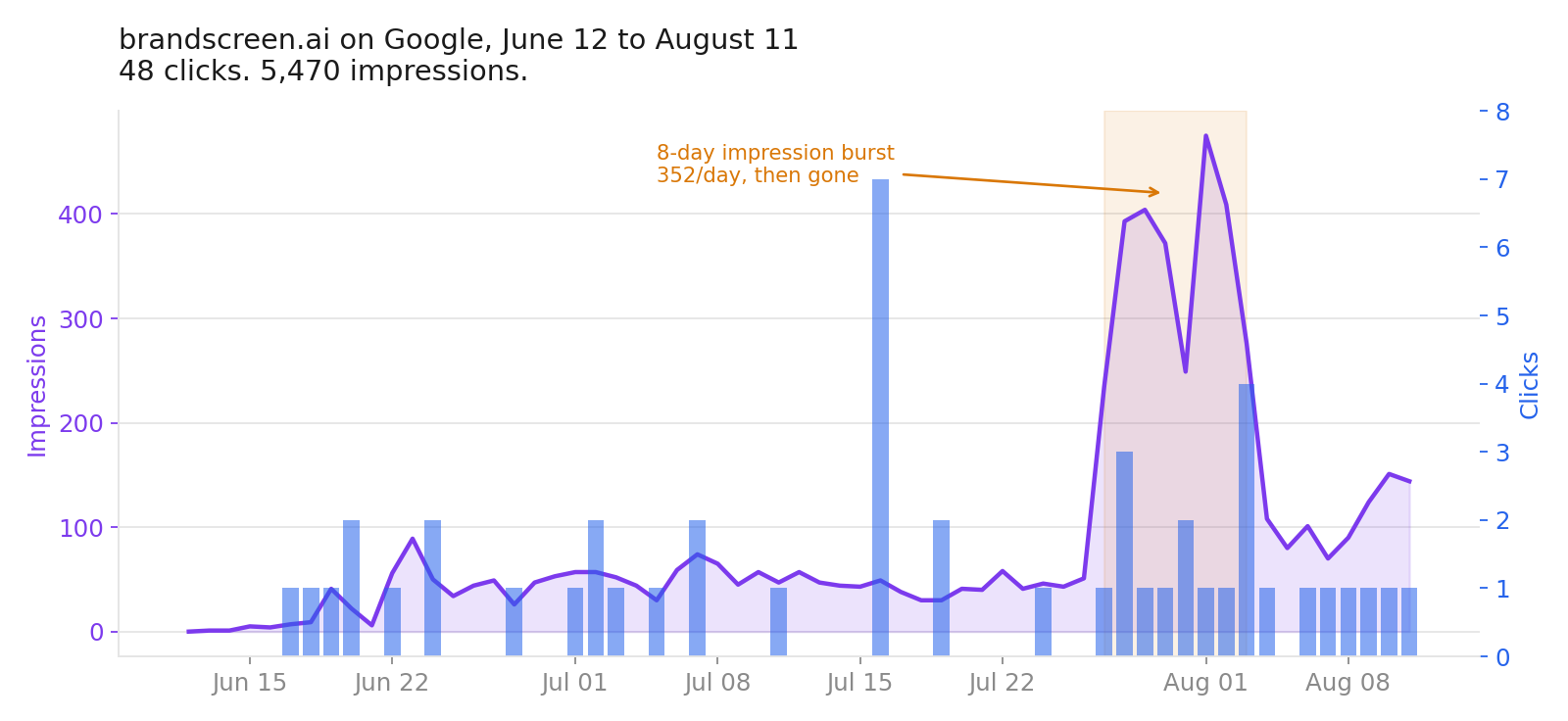
48 clicks. 5,470 impressions.
Not 48 thousand. 48.
I am putting that up front because every article about domain migration is written as if you have something enormous to lose. Most people reading this do not. I definitely did not.
The trap in that graph
Look at the last week of July. Impressions go from about 40 a day to 400 a day, hold for eight days, then fall back.
Split into the three periods it actually contains:
| Period | Impressions per day | Clicks |
|---|---|---|
| Jun 12 to Jul 26 | 40 | 27 |
| Jul 27 to Aug 3 | 352 | 14 |
| Aug 4 to Aug 11 | 108 | 7 |
Impressions went up almost 9x. Clicks did not move.
I wanted to know what that was, so I pulled the indexing report and put it on the same axis.
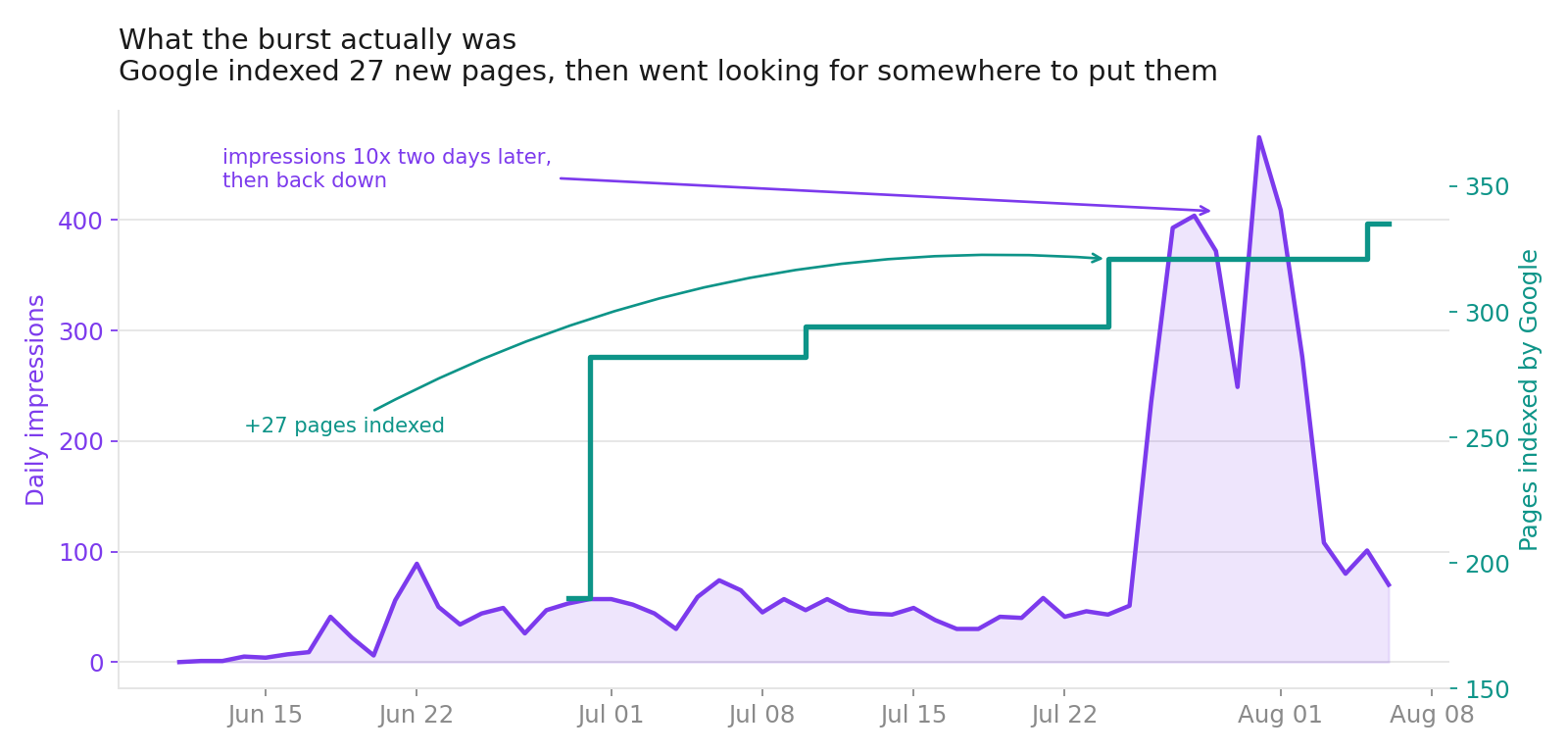
On July 24, Google indexed 27 new pages of my site. Two days later, impressions went up 10x. Eight days after that they came back down.
That was not growth. That was Google finding new pages, going out to see if anyone wanted them, getting no clicks, and quietly withdrawing.
I am glad I know this, because it is the exact thing that would have wrecked the rest of this series. If I compare my post-migration numbers against 352 a day I will report a disaster that never happened. If I compare against 40 a day I will report a win I did not earn.
So I am saying it now, before I know the outcome. The honest baseline is 40 impressions a day normally, about 108 a day on the day I switched. I will hold myself to that when the numbers come in.
Where the clicks were actually coming from
This is the part that changed how I thought about the whole move.
28 of my 48 clicks came from one page. The homepage. My top two queries were "brandscreen" and "brand screen", at position 2.2 and 2.9.
That is people typing my name into Google. It is not people finding me by searching for a problem I solve.
So I had close to zero non-brand organic traffic to lose. The thing everyone warns you about with domain migrations, tanking your rankings, was not really a risk for me. There were barely any rankings there to tank.
My biggest actual asset was one blog post about how to check if a name is trademarked. 1,870 impressions, 5 clicks, average position 36. A third of all my impressions came from that single URL.
Google and Bing are not the same weather
I pulled Bing for the same days.
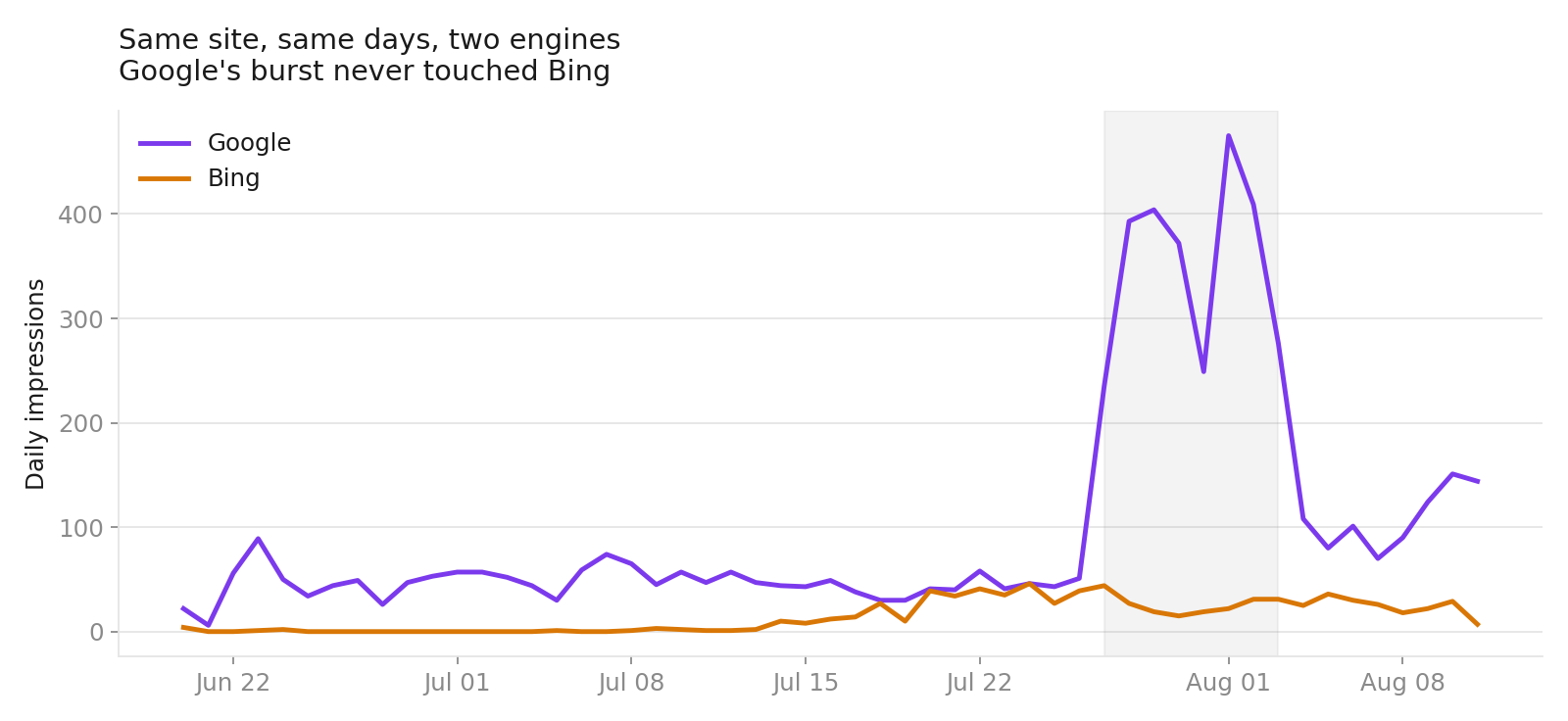
Bing sat flat at 20 to 40 impressions a day straight through Google's burst. Same site, same days, and one engine had an event the other never noticed.
Then I looked at what Bing has actually indexed.
Google: 335 pages. Bing: 13.
And not one of the 13 is a blog post. My biggest asset on Google, the trademark article, does not exist in Bing's index at all.
Which would be a footnote, except Copilot cited BrandScreen 487 times over the same period. Those citations are coming off a thirteen page index of my marketing pages. Almost nobody clicks through from Bing, and Copilot is quoting me constantly.
That gap is the most interesting number I have.
The thing I actually want to find out
Those 487 citations point at brandscreen.ai URLs.
Google's handling of a 301 redirect has been documented for twenty years. What ChatGPT or Copilot or Perplexity do with one is not documented anywhere I could find. Do they follow it. How long does it take. Does a cited URL keep getting cited after it moves, or does the source just quietly drop out of the answer.
I took a baseline before I switched. Eight prompts, four engines, fresh logged out sessions, same day every week. 32 data points a week.
That is the real reason I am writing this series.
What has happened so far
I flipped the redirects on August 7, 2026.
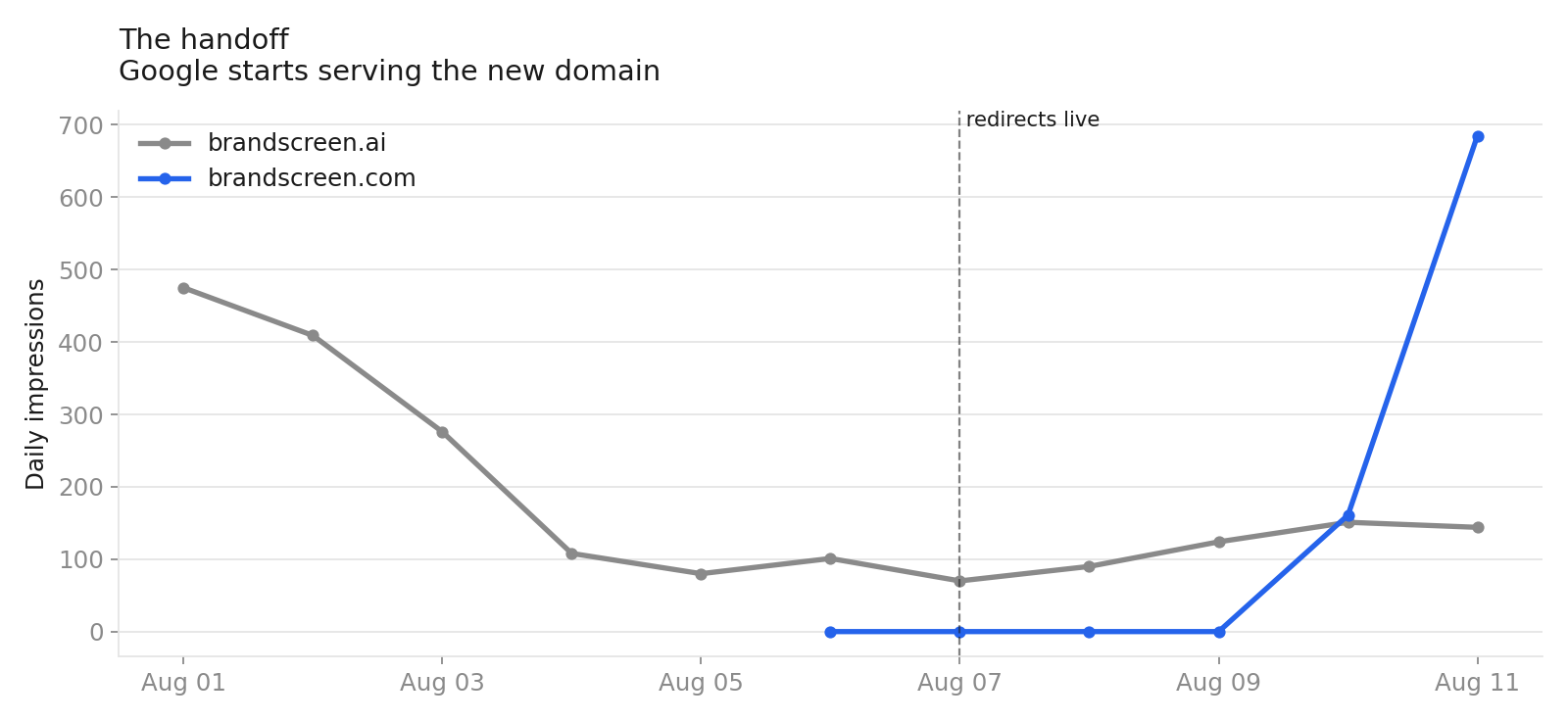
Google started serving the .com on August 10. First day 161 impressions, second day 685.
The .ai has not gone to zero yet. That is normal and it takes weeks. Though a two month old domain has a lot less indexed history to unwind than an established one, which may be why the next part happened so fast.
On the .com, the query "brandscreen" is already at position 1. My brand search re-pointed within days.
Everything else looks worse before it looks better. My domain checker tool page was at position 39 on the .ai. On the .com it came back at position 90. Going by what I learned from the July burst, that is Google treating it as a new URL and going out to see where it belongs. I expect it to climb back. If it is still at 90 in mid September, something is wrong and I will say so here.
What I am tracking
Every Monday. Impressions on the .com. Impressions still on the .ai. Pages indexed on each, which is a much cleaner progress signal than impressions. The position of the domain checker page. Whether the trademark post has appeared on the .com yet. Bing citations.
Plus the 32 AI citation checks.
Next
Post 2 is the audit. Every place the old domain was hardcoded, the ones I missed, and what I found out about brandscreen.com having a previous life going back to 2014.
Post 3 is what broke.
I will post the numbers whichever direction they go.
If you are picking a name right now, BrandScreen checks the trademark, the domain and the handles before you commit. It is free to run one.