How to check if a business name is already registered
A business name can be registered in one state and free in another. How to check, what a match actually blocks, and where the search stops being useful.
How to check if a business name is already registered
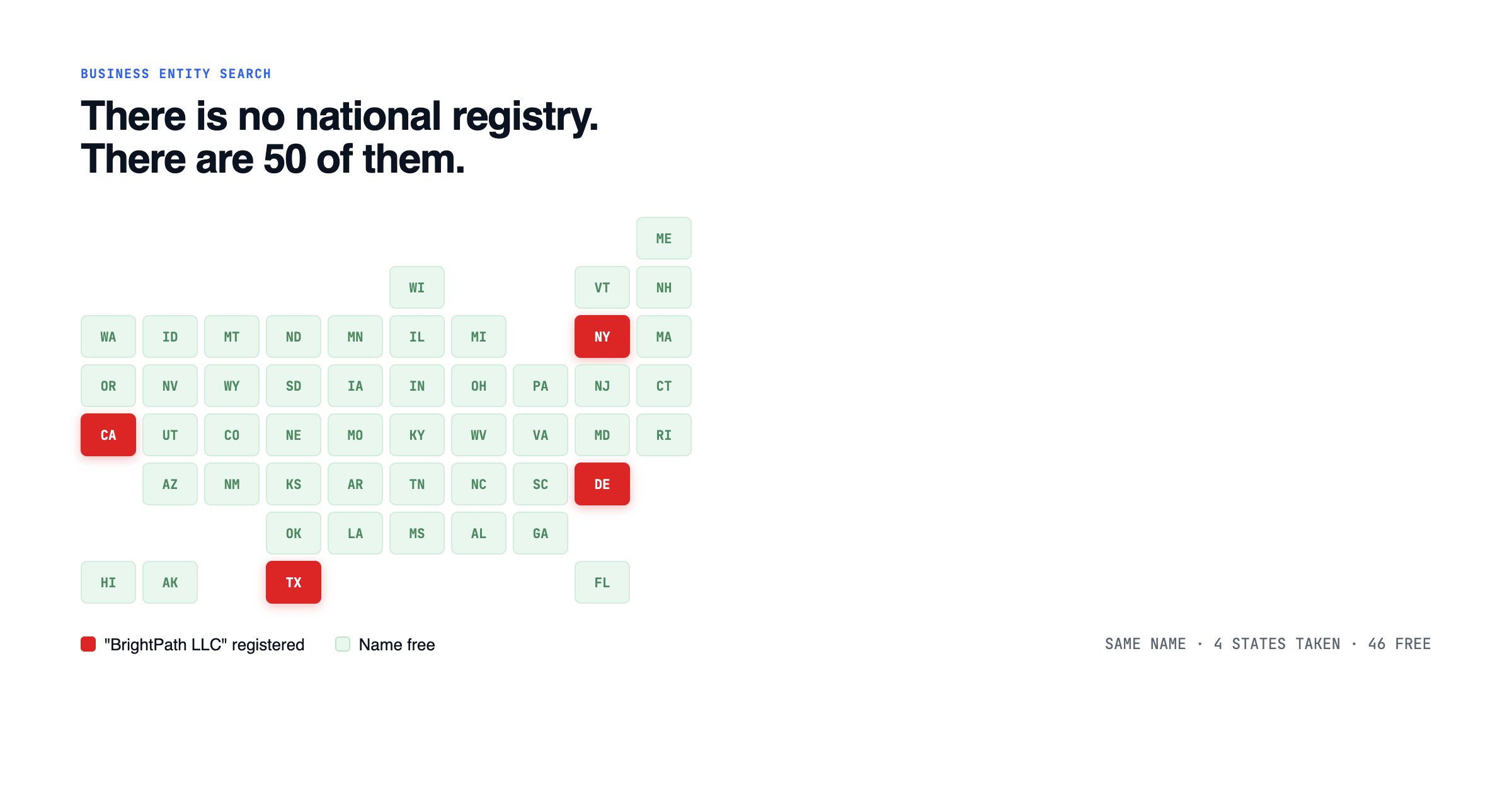
Business name registration is state by state. There's no national registry.
A name registered in Delaware tells you nothing about California. A clean search in both tells you nothing about trademark rights, which work on a different axis entirely.
That fragmentation is why this is confusing. Here's how to check.
Start with the Secretary of State
Every state runs a business entity search and every one of them is free. The names vary. Division of Corporations, Corporations Division, Business Entity Search. They all do the same thing: search the register of companies formed or qualified to do business in that state.
Search the state where you'll incorporate first, then the state where you'll actually operate. For most startups that's Delaware plus home.
You're looking for an exact or near-exact match on an active entity. What you'll get is a list that includes dissolved shells from decades ago, which is where most people go wrong.
An active match and a dead one look the same
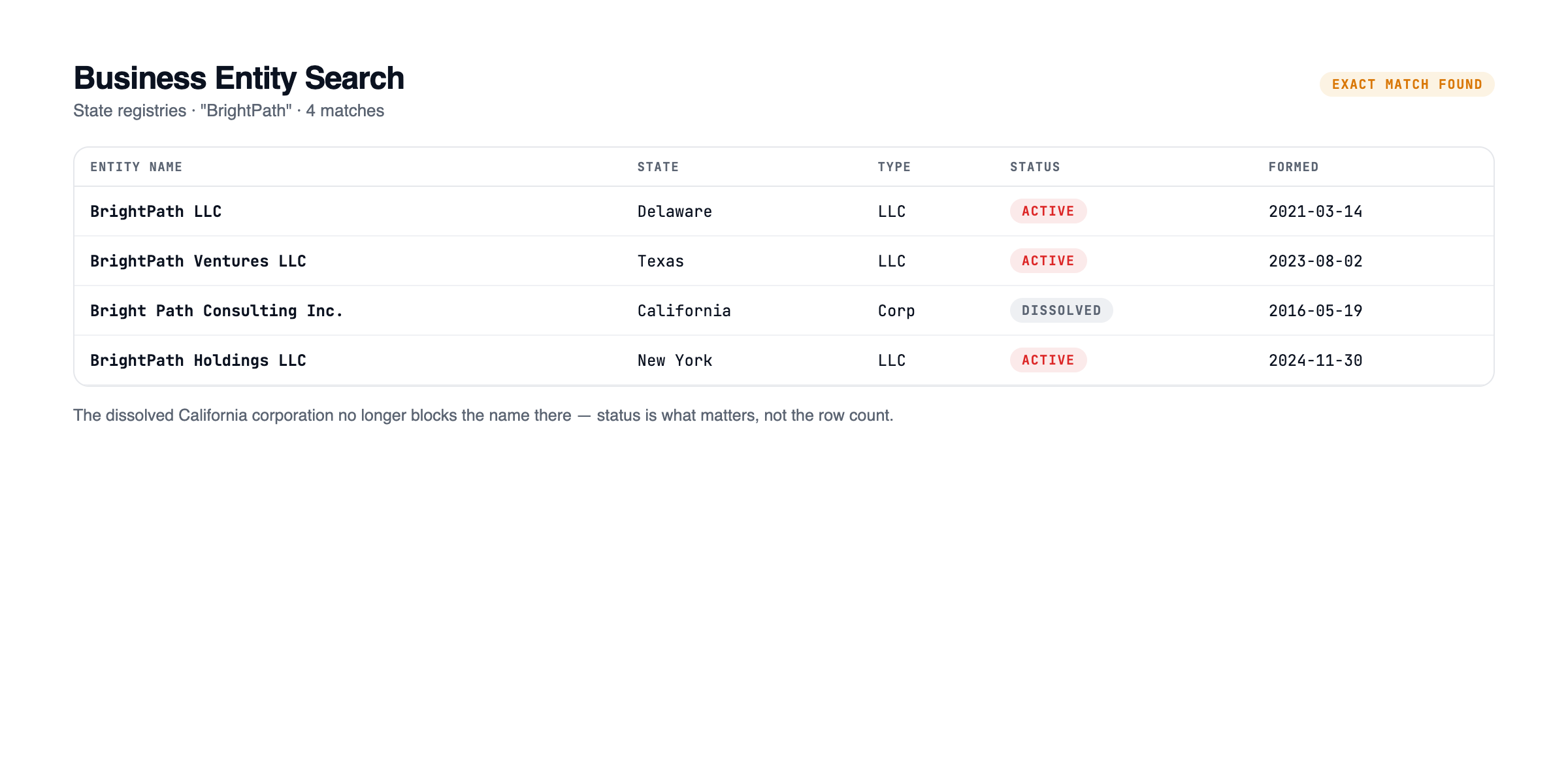
State results list entity names with almost no context. A company dissolved in 1974 sits next to a competitor that filed last month. Both look like conflicts. Only one is.
Check the status on every match.
Active. The name is taken for that entity type in that state.
Inactive, dissolved, revoked, forfeited. The name may be available. Some states hold names for a period after dissolution, so check the state's rule.
Administratively dissolved. The company stopped filing annual reports. It can often be reinstated, so the name isn't reliably free.
Check entity type too. Most states block an exact match only within the same type. An LLC and a corporation with the same name can sometimes coexist and sometimes can't. It varies, and it's worth reading the state's own rules instead of assuming.
What a match actually blocks
This changes how much a conflict should worry you, so it's worth getting straight.
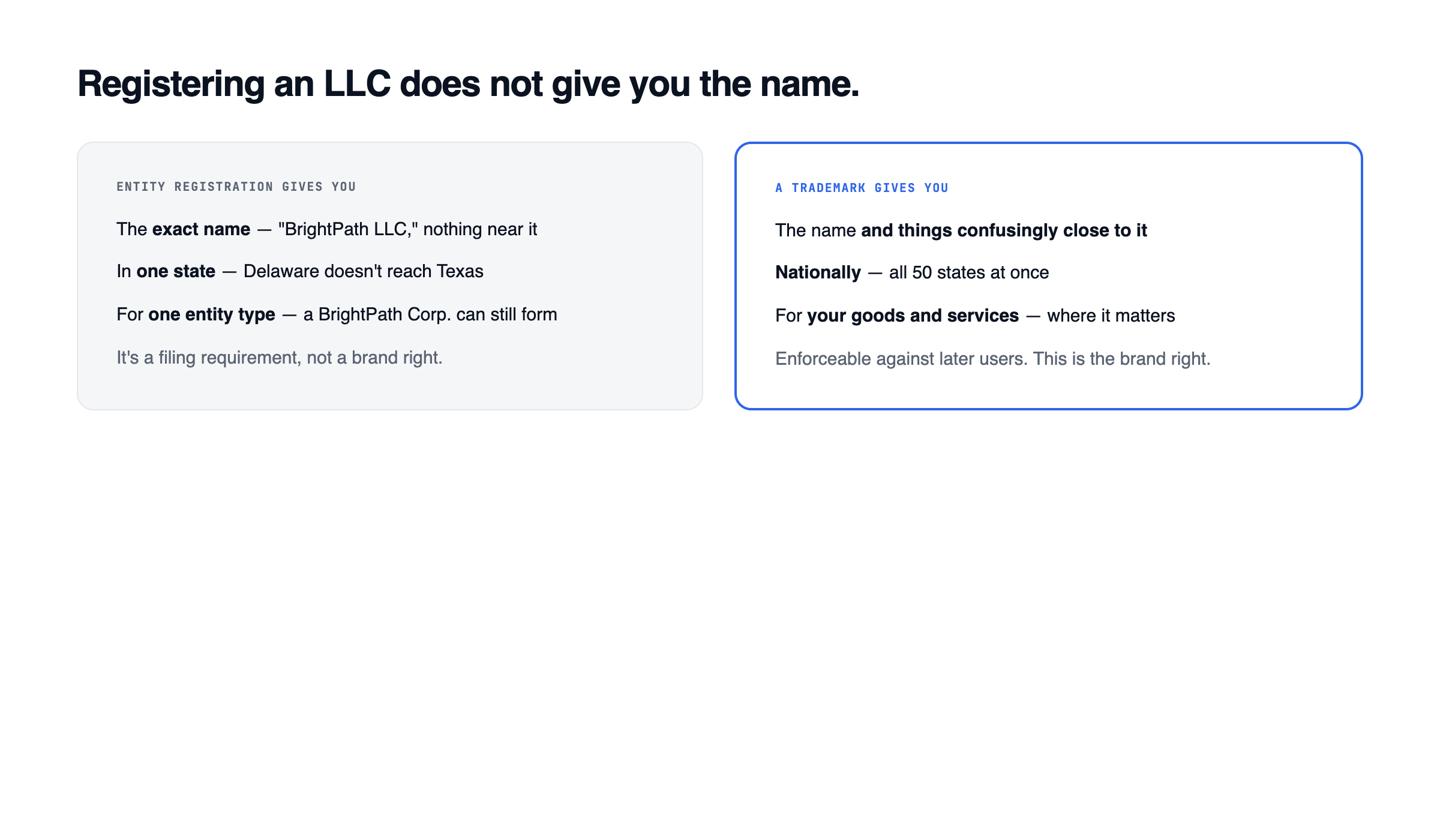
A registered entity blocks the exact name for that entity type in that state. It does not stop you registering the same name in another state. It does not stop you using the name as a brand. It gives the holder no trademark rights. And it doesn't prevent you adding a distinguishing word and filing anyway.
That last one is how most conflicts get resolved. "Northwind Systems" being taken in Delaware doesn't block "Northwind Labs." States generally require names to be distinguishable, not unique, and a real word of difference is usually enough.
The reverse is more dangerous. A clean entity search does not mean the name is safe. Entity registration and trademark rights are separate systems. You can register a business name in all fifty states and still be infringing a trademark.
Check the fictitious name registers too
If you'll trade under a name that isn't your legal entity name, most states require a DBA. Doing business as, also called fictitious name, assumed name, or trade name depending on where you are.
These are sometimes filed at county level rather than state, which means a separate search. And a name can be registered as a DBA by a business whose legal name is completely different, so it won't show up in an entity search at all.
Where this stops being useful
Entity search answers one narrow question. Is this exact name on this state's register. It's a knockout check. Good for ruling names out, not for clearing them.
It won't tell you about trademark rights, federal or common-law, which can be held by someone who never registered an entity anywhere.
It won't tell you about common-law use, where a business trading under a name for years has enforceable rights in its region without ever filing anything.
It won't flag similar names an examiner might consider not distinguishable.
And it won't tell you about other states unless you search each one.
If a name matters enough to build on, entity search is step one of several. A trademark attorney is the step that actually clears it.
Doing it faster
Checking one name across a few states, the trademark register, five domain extensions, and eight social platforms takes twenty minutes to an hour of tab-switching. For a shortlist of ten names it's most of a day.
BrandScreen runs all of it at once and gives you one report. Entity registrations, USPTO trademark matches, domain availability, social handles, search competition, and a Brand Score summarizing how contested the name is. Full reports are free.
It's the same knockout screen described above, run in parallel instead of by hand. It isn't a legal clearance search and it isn't legal advice. For a name you're committing to, talk to a trademark attorney before you file.
Related: How to check if a name is trademarked · What trademark class does my business need?
If you are still choosing, our screened name index lists names we have already checked against the trademark register, the domain registries and state entity records.