What trademark class does my business need?
There are 45 classes and picking wrong is expensive to fix. How classes work, which ones software and consumer businesses land in, and why the goods description matters more than the number.
What trademark class does my business need?
Trademark rights aren't granted over a word. They're granted over a word for particular goods or services.
That's why Delta is an airline and a faucet company, and why both are fine.
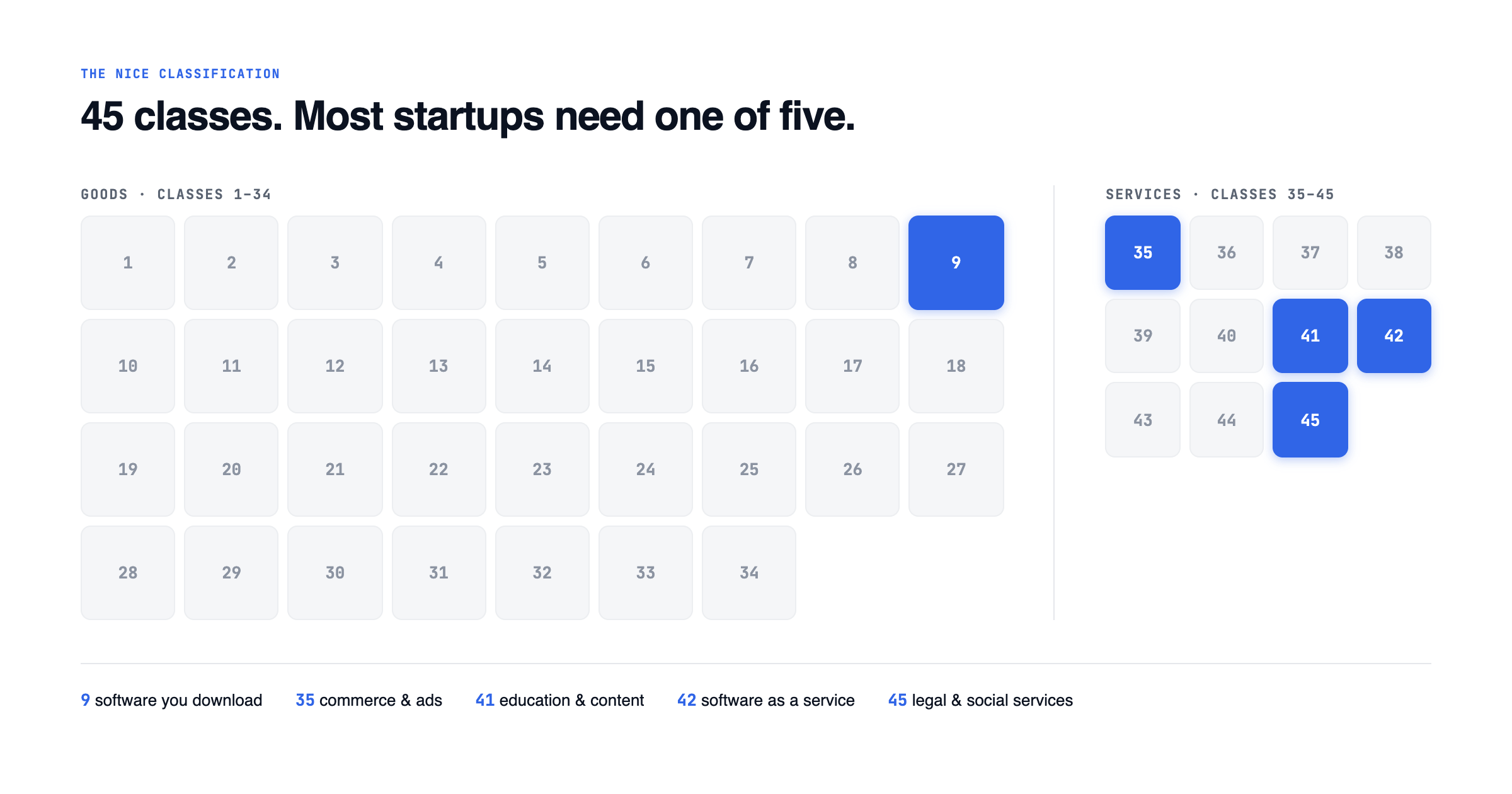
The system that carves up "particular goods or services" is the Nice Classification. 45 classes, numbered 1 to 45. Classes 1 through 34 are goods, 35 through 45 are services. Every application specifies at least one.
Why the class decides everything
Two marks can coexist if their classes and actual markets are far enough apart that customers wouldn't be confused. Two marks in the same class for similar goods generally can't.
This cuts both ways when you're screening a name.
A conflicting mark in your class is a serious problem. A conflicting mark in an unrelated class may be no problem at all. And your own registration only protects you in the classes you filed in.
That last point gets underestimated. Registering in Class 42 for software doesn't stop someone using your name on t-shirts in Class 25. If merch matters to your brand, that's a second class and a second fee.
Where software businesses land
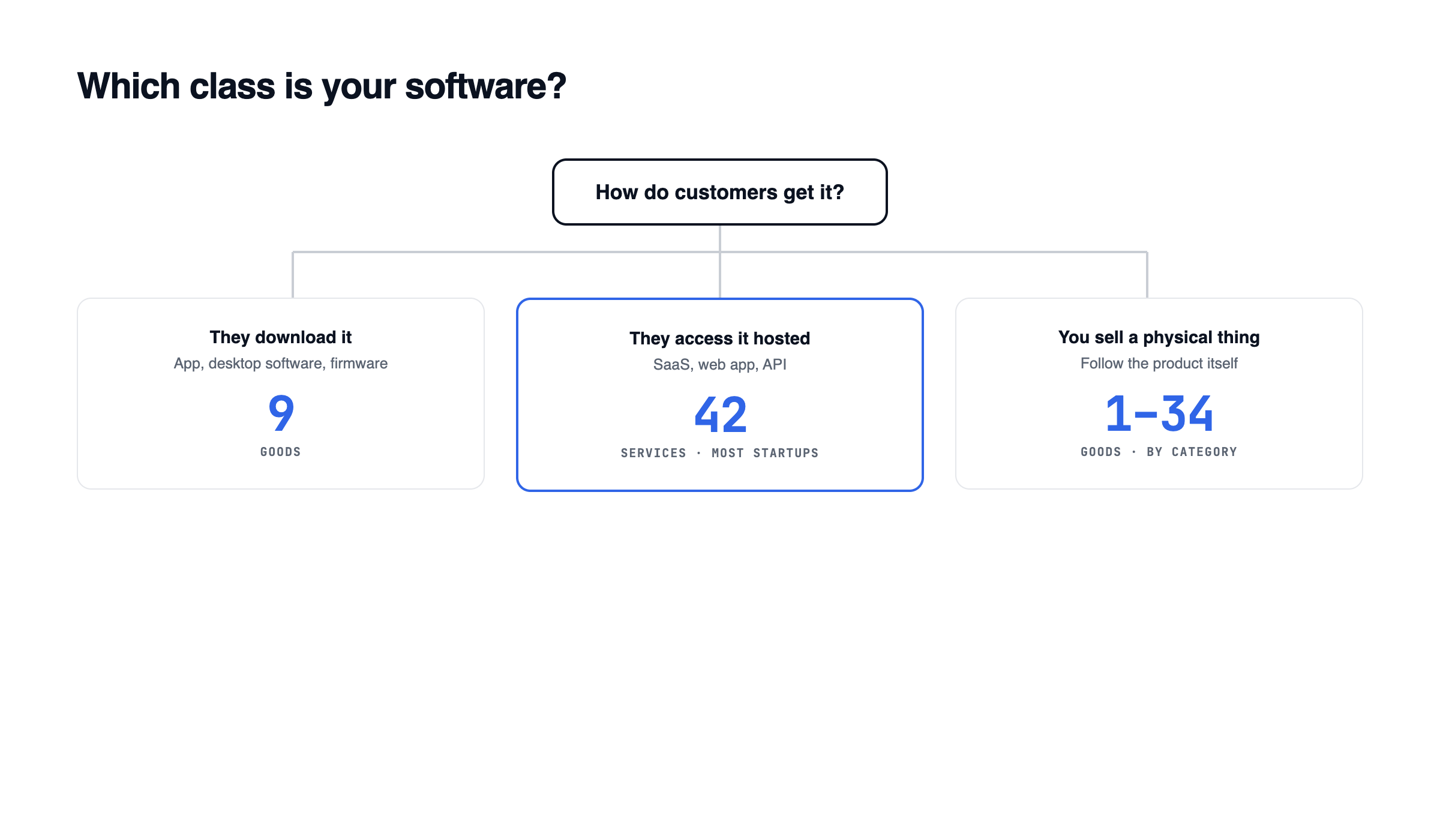
Class 42, scientific and technological services. This is SaaS. "Software as a service (SAAS) services featuring software for [what it does]" is the standard formulation. If you sell access to software you host, this is you.
Class 9, computer software and hardware. Downloadable software, mobile apps, physical devices. If a customer downloads or installs your product you're probably here instead of 42. If you have both a downloadable app and a hosted service, possibly both.
Class 35, advertising and business services. Marketing, business consulting, retail and online store services, data processing. Marketplaces and e-commerce platforms often need this alongside 42.
Class 41, education and entertainment. Courses, training, publishing, media, events, games.
Class 45, legal and security services. Narrower than it sounds. Most tech companies don't need it.
Physical products
Class 25 is clothing, footwear, headgear. Merch.
Class 30 and 29 are foodstuffs, split roughly between prepared goods (30) and meat, dairy, and preserved foods (29).
Class 32 and 33 are drinks. Non-alcoholic in 32, alcoholic other than beer in 33. Beer is in 32.
Class 3 is cosmetics and cleaning preparations. Class 5 is pharmaceuticals and supplements.
If you sell a physical product the class follows the product, not the business model.
The description matters more than the number
The class number is a filing convenience. What actually defines your rights is the identification of goods and services, the sentence describing what the mark is used for.
Write it too narrow and you protect less than you meant to. Write it too broad and the examiner refuses it, or you end up with a registration that's vulnerable to cancellation for goods you never sold.
The USPTO publishes an ID Manual of pre-approved descriptions. Using one is faster, cheaper, and less likely to draw an office action than writing your own. Start there.
You also have to be using the mark in commerce for everything you claim, or have genuine intent to. Claiming goods you don't sell is a real vulnerability, not a technicality.
Multiple classes cost multiple fees
USPTO fees are per class, per application. Three classes costs roughly three times one, before attorney fees.
For an early-stage company the usual advice is to file in the class covering what you actually sell today and add classes as the business expands. A registration you can defend in one class beats a thin filing across four.
Checking conflicts by class
When you search the register and find a mark matching your name, the first question is which class and what it covers.
An exact name match in an unrelated class, for a business in a different market, usually isn't the blocker it looks like. An approximate name match in your own class, for a competing product, is a much bigger problem than the exact match.
Which is why "is the name taken" is the wrong question. The right one is whether anything confusingly similar is registered for goods like yours.
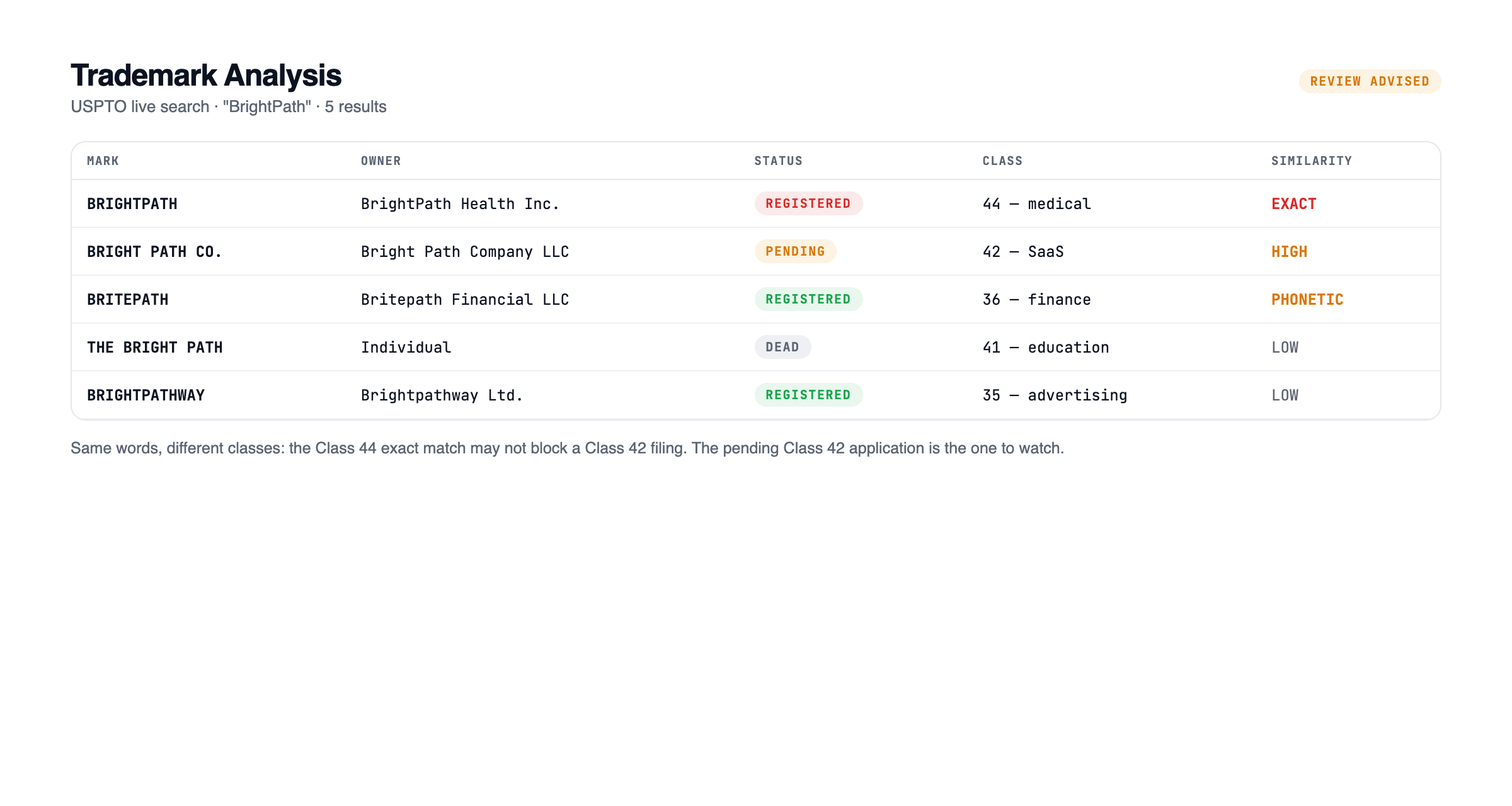
BrandScreen runs a knockout search of the USPTO register and returns matching marks with owner, status, and class, alongside domain availability, entity registrations, social handles, and search competition. Full reports are free.
Where this stops
Class selection is one of the places where professional advice pays for itself. The number is easy. The identification of goods, the filing basis, and the judgment about which conflicts matter are not.
This describes how the system works. It isn't legal advice, and a knockout search isn't a clearance search. Before you file, talk to a trademark attorney.
Related: How to check if a name is trademarked · Someone filed a trademark on your brand name